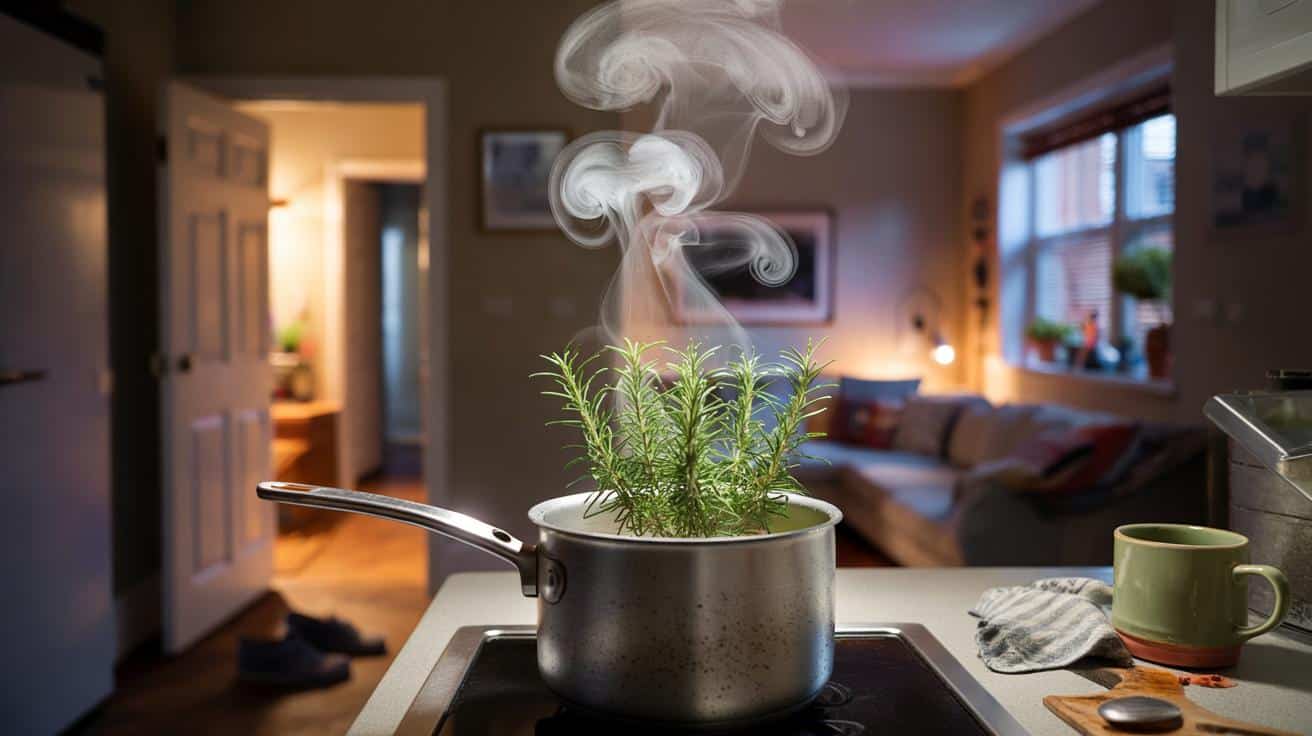
The saucepan was forgotten on the back hob, flame low, water trembling.
Only the smell was present. A soft, green, almost clean warmth that crept down the hallway and into the living room, cutting through the sour trace of last night’s takeaway and damp shoes by the door. The radio was on, the window barely open a crack, London buses grumbling outside. Inside, something had shifted without anyone touching the light switch.
She walked back into the kitchen and blinked. It wasn’t the same room. The air felt lighter, less heavy on the lungs. No plug‑in diffuser, no candle with a name like “Nordic Forest at Dawn”. Just a humble bunch of rosemary, half wilted, rescued from the back of the fridge and tossed into boiling water, quietly doing its thing. The saucepan hissed very softly, as if in on the secret.
We talk a lot about changing the vibe of a room with furniture, colours, big renovation projects. Yet sometimes it’s the smallest, almost accidental ritual that does the real work. And this one comes with a simple ventilation trick that makes all the difference.
Why a pot of boiling rosemary changes how a room feels
Walk into a room where rosemary has been simmering for ten minutes and your brain reacts before you’ve even named the smell. There’s a tiny lift in the chest. Shoulders drop a notch. The herbal, camphor-like notes cut through cooking odours, stale air, that vague “closed window” scent so many urban flats carry. It doesn’t scream fragrance. It whispers freshness.
The vapour is warm, not perfumey like a spray. It wraps itself around fabrics, soft furnishings, even that jumper you left on the back of the chair. The place suddenly feels cared for, like someone has just finished a lazy bit of Sunday tidying. Sometimes that’s all a room needs: for the air to feel touched by a human hand.
On a grey Tuesday evening in Manchester, I watched a young couple try this in their rental kitchen. Thin walls, no extractor fan, lingering smell of fried onions. They brought an old saucepan to the boil, tossed in four rough sprigs of supermarket rosemary and let it roll. Ten minutes later, their flatmate came home and stopped at the door. “Did you clean?” he asked, suspicious.
Nothing had moved. The sink was still full, the bin still waiting. What had changed was the emotional reading of the space. The herbal steam masked the greasy notes that signal “mess” to the brain and replaced them with something that reads as intentional. That tiny sensory trick softened the whole atmosphere. They sat down at the table in a room that suddenly felt almost like a café, and they stayed there longer than usual.
There’s a bit of science behind this domestic sorcery. Rosemary contains volatile compounds like cineole and camphor that are released with heat and carried on steam. These molecules hit the olfactory receptors, which plug straight into the limbic system, the part of the brain that handles mood and memory. You’re not just smelling “nice herb”. You’re triggering associations with gardens, roasts at your nan’s, Mediterranean holidays, or simply “freshness”.
*The result is quiet, almost invisible mood work.* You haven’t repainted, decluttered, or bought anything expensive. You’ve changed the air. And when the air feels different, the room feels different. That’s where a simple ventilation trick can turn a pan of rosemary into a whole‑flat reset, rather than just a kitchen corner moment.
How to boil rosemary properly (and the ventilation tip everyone forgets)
The method couldn’t look simpler: water, heat, rosemary. Yet the details matter. Start with a medium saucepan, half filled with fresh water. Bring it to a gentle boil, not a roaring one. You want steady bubbles, not an angry splash. Toss in three to six sprigs of rosemary, fresh or dried, and immediately turn the heat down to a soft simmer.
➡️ Abdominal fat after 60 responds better to timing than intensity
➡️ How people naturally reset after social interactions without isolating
➡️ Paid to live on a remote island: what these programs typically ask for beyond the headline perks
➡️ “Poor people’s fish” returns when supply chains favor local catch again
➡️ Old furniture looks dull not because it’s damaged, but because the finish reacts to modern cleaners
➡️ How emotional overload distorts perception of problems
Leave the lid off. This is key. You’re not making stock, you’re releasing vapour. Within two or three minutes, the kitchen will start to shift. Let the pan simmer for 15 to 20 minutes, topping up with a little hot water if it drops too low. Keep an eye on it in a normal, human way — like you’d watch pasta or tea. Soyons honnêtes : personne ne fait vraiment ça tous les jours.
Now the big shift: the ventilation move. Once the rosemary has been simmering for about ten minutes and the smell is clearly present, crack open a window in the room next door, not right above the hob. If you have a small flat, open the farthest window instead. This creates a gentle current that pulls the scented steam through your space rather than letting it hang stubbornly in the kitchen.
It’s a tiny change, but it turns your saucepan into a slow, herbal diffuser for the whole home. On colder days, open the window just a narrow slit and close doors to rooms you don’t need to refresh. Let the air do the work while you go back to your emails, your book, your doomscrolling. You’re not trying to fumigate the house. You’re nudging the atmosphere.
There are mistakes that quietly sabotage this ritual. The first is overdoing it. If you pack the pan with rosemary and simmer it for an hour, the smell can slide from uplifting to medicinal. That’s when partners start asking what on earth you’re “cooking” and not in a good way. Less herb, shorter simmer, better vibe.
The second trap is ignoring safety because “it’s just herbs”. A forgotten pan on full heat can burn dry and scorch, filling the flat with smoke and a bitter, hospital-corridor smell. Keep the heat low and the water visible. Treat it as a living object in the room, not a background appliance. And yes, turn on your extractor if you have one — it will still carry the rosemary notes, just more gently.
I hear often from people in small studios who worry about opening windows: the noise, the cold, or the neighbour’s cigarette smoke drifting in. That’s where micro‑ventilation comes in. A two‑finger crack in the top of a window for ten minutes can refresh surprisingly well when paired with herbal steam. You don’t need a breezy draft; you just need movement.
“I thought scent was about buying the right candle,” says Alex, who started boiling rosemary after a friend’s tip. “Then I realised it was really about air. The rosemary just gives the air a story.”
To anchor this in daily life, it helps to think in small, repeatable moves rather than grand rituals that you’ll drop after a week.
- Keep a cheap bunch of rosemary in a jar of water by the sink, ready for the pan.
- Link the simmering to something you already do: brewing evening tea, washing up, lighting the lamp.
- Use the “ventilation window” as a mini break: open it, stretch, check in with your body, then walk away.
On a day when everything feels slightly off — the flat, the mood, the weather — that simple combination of steam and air can act like a reset button. On a very human level, it says: someone lives here, and they care enough to change the air.
Beyond the herb: what this small habit does to your routines
A pan of boiling rosemary is an excuse to pause. You fill it, you light the hob, you wait. In those few quiet minutes, the flat starts breathing differently. It’s not a productivity hack or a wellness routine wrapped in jargon. It’s just a concrete, almost domestic spell you can cast on a Tuesday at 6.43pm when you’re too tired for anything elaborate.
We’ve all had that moment where the house feels like it’s sitting on our chest. Laundry on the chair, stale smell of lunch, the laptop still open on the sofa. You don’t have the energy to deep clean, but you also can’t stand one more hour inside the same air. Boiling rosemary doesn’t fix your to‑do list. It just buys you a sensory exhale. Often, that’s enough to make the rest feel a bit more doable.
The nice thing is how shareable it is. Guests come over, sniff, and ask, “What’s that smell?” You tell them about the sprigs in the pan, the cracked window, the gentle current running through the flat. It’s the kind of low‑tech, neighbour‑friendly trick people pass on in group chats and stairwell conversations. Almost old‑fashioned, in a good way.
Once you’ve tried it a few times, you start to notice how your home behaves with air. Which window creates a cross‑breeze. Which door, left ajar, lets the scented vapour curl down the hall. That simple awareness can quietly shift your relationship to your space. You’re not just living in rooms; you’re tuning them. With water, a plant, some heat, and a little bit of attention.
| Point clé | Détail | Intérêt pour le lecteur |
|---|---|---|
| Boiling rosemary resets a room’s mood | Simmering a few sprigs releases herbal vapours that cut through stale or greasy odours | Permet de changer l’ambiance sans grands travaux ni achats coûteux |
| The ventilation trick matters | Opening a window in a different room creates a gentle current that spreads the scent | Optimise l’effet dans tout le logement, même petit ou mal aéré |
| Ritual over perfection | Short, simple sessions linked to existing habits work better than rigid routines | Facile à intégrer dans la vraie vie, sans pression ni culpabilité |
FAQ :
- Can I use dried rosemary instead of fresh?Yes. A tablespoon of dried rosemary works well. The scent is slightly different, a bit sharper, but still effective for refreshing the air.
- How long should I boil the rosemary for?Usually 15 to 20 minutes of gentle simmering is enough. You can stop earlier if the room already feels different, or top up the water and continue a bit longer.
- Is it safe to leave the pan unattended?Better not. Keep the heat low, stay in the flat, and glance at the water level from time to time. Treat it like boiling pasta or making tea, not like a candle you forget.
- Will this replace an air freshener or diffuser?It can, depending on what you want. It won’t add a heavy perfume, but it does a good job of clearing “background” smells and creating a fresher, more natural vibe.
- Does the ventilation tip work in a very small studio?Yes. Even a slight crack in a single window helps. Pairing herbal steam with a bit of airflow is what spreads the effect beyond just the kitchen area.