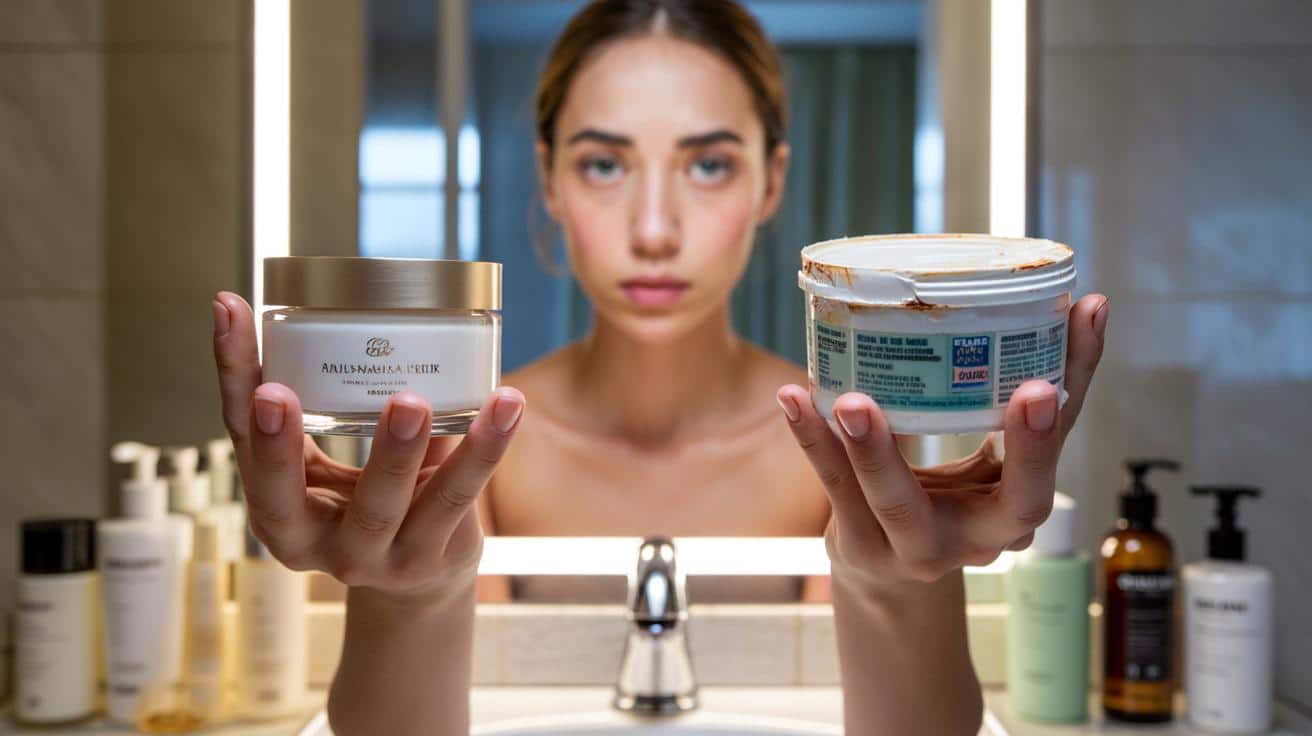
The woman in the pharmacy aisle looked genuinely torn.
In her left hand, a glass jar with a gold lid, heavy and expensive-looking. In her right, a slightly dented plastic tub with a discount sticker, the kind you glance at and instinctively downgrade in your head.
She rubbed a dab of each between her fingers, checked the price labels once more, then sighed and dropped the cheaper one back on the shelf. The luxury jar went into the basket, almost guiltily, like a secret treat.
Her skin, of course, would never know the difference. Her brain, on the other hand, had already taken sides.
Why the cheap tub quietly wins on your bathroom shelf
In almost every bathroom you walk into, there’s a pattern. Front and centre: a proudly displayed moisturiser with a famous name and a pleasingly heavy lid. Hidden behind deodorant or a random SPF: a scuffed, supermarket own-brand cream that “does the job”.
The quiet truth is that the hidden one often ranks higher where it actually counts: on the skin. It glides on the same. It sits on the barrier the same. It traps water in roughly the same way as that luxury jar that cost five times more.
Your skin doesn’t have a loyalty card. It just reacts to molecules.
Dermatologists have been pointing this out for years, sometimes with a mix of patience and resignation. A 2022 UK consumer survey on basic moisturisers found that when labels were removed, participants rated a £5 cream almost identically to one retailing at £65.
Texture, scent, that quick rush of “ooh this feels fancy” did shift first impressions. Once testers used the products for a week, their judgments drifted back toward hydration, comfort and irritation. Price stopped being a reliable signal. Real-world results took over.
Brands know that first impressions sell. So they lean into frosted glass, muted pastels, featherlight fonts. The cheaper tubs stay looking like something your nan might have kept in her bedside drawer. Even when the formula inside is strikingly similar.
Strip away the storyline and moisturisers are unexpectedly simple. You’ve got humectants (like glycerin and hyaluronic acid) that pull water in. Emollients (like squalane or certain plant oils) that smooth the surface. Occlusives (like petrolatum or dimethicone) that lock everything in.
➡️ How people naturally reset after social interactions without isolating
➡️ Why some people greet dogs: psychologists connect it to social openness, not “quirkiness”
➡️ Abdominal fat after 60 responds better to timing than intensity
➡️ Boiling rosemary: the simple habit that changes the vibe of a room (and the ventilation tip)
➡️ How emotional overload distorts perception of problems
➡️ Injecting water into oil fields: why it can reduce sinking—until it doesn’t
➡️ Paid to live on a remote island: what these programs typically ask for beyond the headline perks
Most skin doesn’t “recognise” Chanel, CeraVe or the supermarket’s budget line. It recognises whether its barrier is supported or irritated. Whether the formula is bland and functional, or overloaded with perfume and potential allergens. *From a biological point of view, your skin cares about structure, not status.*
What branding does is shape expectation. It sets up a promise that influences how we interpret every tingle, every glow, every imaginary tightening. But the epidermis never saw the campaign.
How to read a £5 moisturiser like a pro
If skin doesn’t care about branding, the smartest move is to start reading ingredients like a quietly sceptical detective. Not obsessively, just enough to spot the usual suspects.
Eye the first five ingredients. That’s where much of the real action lives. Water, glycerin, petrolatum, caprylic/capric triglyceride, cetearyl alcohol: these are the backbone of countless dermatologist-approved creams, cheap and expensive.
When a £5 bottle and a £45 jar share that same backbone, it tells you something powerful: the packaging is doing a lot of the heavy lifting.
The simplest method is the least glamorous. Go to the supermarket or the chemist with ten minutes to spare and no rush to buy. Pick up a budget moisturiser for “dry and sensitive skin” and compare its ingredient list to a premium one claiming barrier repair or “derm-grade hydration”.
Spot the repeats. Glycerin. Ceramides. Niacinamide. Sometimes identical preservatives. Often even the same type of dimethicone, just at slightly different levels. You’ll start noticing that what felt like a wild market is more like a small town with the same handful of characters changing outfits.
We’ve all scrolled reviews where someone insists a £3 cream “saved my skin” after a luxury routine failed. That kind of story repeats because, quite often, the cheaper formula is quieter. Fewer fragrant botanicals, fewer trendy acids, fewer “actives” that look great in an ad but freak out a fragile barrier.
The logic is brutal and weirdly liberating. Your face doesn’t rate products by their shelf appeal. It rates how non-irritating, hydrating and consistent they are. Price doesn’t map onto that as cleanly as marketing suggests. Once you accept that, the pharmacy aisle starts feeling less like a beauty hall and more like a toolbox.
Turning your moisturiser into a tool, not a trophy
The easiest way to win this game is to separate function from ego. Start by asking your skin one clear question: “What do you actually need right now?” Then match the answer to texture and ingredients, not brand tier.
Very dry or eczema-prone? Go thick, simple, fragrance-free, often in a big, boring tub. Oily or acne-prone? Go lighter, gel-cream textures, labelled non-comedogenic, with humectants front and centre. Normal-but-confused? Aim for mid-weight creams with ceramides and glycerin, nothing dramatic.
Once you nail that match, the label logo matters a lot less than you’ve been led to believe.
Most people layer far too many “fancy” things and then blame their skin for complaining. A more forgiving approach is to pick one cheap, basic moisturiser as your anchor. Use that daily, and only change one product at a time around it.
Skip the idea that a moisturiser has to “do everything”. Its job is to hydrate and protect. Anti-ageing? That’s retinoids and suncream. Pigmentation? That’s usually acids, vitamin C and again, SPF. Barrier repair? That’s consistency and calm, not constant experimentation.
Soyons honnêtes : personne ne fait vraiment ça tous les jours. Most of us slap on whatever is within reach, half-asleep, under bad bathroom lighting. That’s why the most realistic strategy is to make the default product on your sink something cheap, gentle and effective.
“Your moisturiser doesn’t need a personality. It needs a purpose,” one London dermatologist told me. “If the formula is right, you can save the romance for a once-a-week mask.”
When you detach skincare from status, small, practical habits start to matter more than unboxing experiences. You might find yourself doing things like:
- Patch-testing a new cream on a small area for 3 nights before going full-face
- Keeping a basic, fragrance-free moisturiser as a “reset button” after any irritation
- Buying a big, budget tub you’re not scared to use generously on face, neck and hands
- Ignoring limited editions and focusing on products that don’t change formula every season
- Checking how your skin feels in the morning, not just how it looks right after application
The emotional shift is subtle but real. You stop chasing miracles in jars and start listening to your barrier the way you’d listen to your sleep or your appetite. Less drama, fewer surprises, more quiet wins.
Skin doesn’t read labels, people do
Once you see that branding and biology speak different languages, you start reading your bathroom shelf like a timeline of moods and marketing waves. The half-used luxury cream from a breakup. The “clean beauty” phase in minimalist packaging. The oddly effective £4 bottle you bought on holiday and slightly resent for working so well.
What happens if the humble one becomes the new default and the prestige jar is just… optional? Not a moral question. A practical experiment. Next time your expensive moisturiser runs out, don’t rush to replace it. Live with the budget one for a full month. No safety net, no “just for special occasions” product on the side.
Notice what actually changes. Texture? Confidence? Bank account? Or just the stories you tell yourself about what your reflection deserves.
| Point clé | Détail | Intérêt pour le lecteur |
|---|---|---|
| La peau ne reconnaît pas les marques | Elle réagit aux molécules et aux textures, pas au logo ou au prix | Libère de la pression d’acheter des produits de luxe pour “bien faire” |
| Les ingrédients de base se répètent | Glycérine, céramides, occlusifs simples se retrouvent dans les crèmes bon marché et premium | Aide à repérer les dupes à petit prix et à lire les étiquettes autrement |
| La constance bat le marketing | Un hydratant simple, utilisé régulièrement, soutient mieux la barrière qu’une rotation de produits tendance | Offre une stratégie concrète, réaliste et économique pour une peau plus stable |
FAQ :
- Are cheap moisturisers really as good as expensive ones?Often, yes. Many affordable creams use the same key hydrators and barrier-supporting ingredients as premium brands. Differences tend to be in packaging, fragrance and marketing, not performance.
- What ingredients should I look for in a budget moisturiser?Look for glycerin, hyaluronic acid, ceramides, squalane, shea butter and simple occlusives like petrolatum or dimethicone, especially if your skin is dry or sensitive.
- Can a cheap moisturiser still be “anti-ageing”?Moisturiser alone won’t rewind time, but a good one will plump fine lines temporarily and support the barrier. True long-term anti-ageing comes more from sunscreen and retinoids than from the price of your cream.
- Is fragrance-free always better?Not always, but it’s safer if you have sensitive or reactive skin. Fragrance is a common irritant. If your skin tolerates perfume well, it’s more a matter of preference than morality.
- How do I know if a cheap moisturiser is breaking me out?Introduce it alone for two weeks, without changing anything else. If new breakouts consistently appear in the same areas, or irritation flares, it may not suit you and you can switch back or try a lighter, non-comedogenic formula.