The old oak sideboard looked tired in the afternoon light, its surface greyed and sticky in places, as if the years had finally caught up with it.
The woman in front of me ran her fingers along the top and frowned. “It wasn’t like this in my grandmother’s house,” she said. “It used to glow.” She’d tried everything she thought was “good cleaning”: multi-surface spray, disinfectant wipes, a squirt of washing-up liquid in hot water. The more she cleaned, the duller it got.
On social media, people told her it was “damaged beyond repair” or “time to sand it back”. A neighbour told her to strip it with harsh chemicals. Yet when a furniture restorer finally walked in, he didn’t see a ruined piece. He saw a finish suffocating under layers of modern cleaners that were never meant to touch it. He smiled, pulled out a bottle of something that looked suspiciously like salad oil… and what happened next didn’t look like magic, but felt like it.
Why your old furniture suddenly looks so tired
Walk into any British home with a bit of history and you’ll spot it instantly: that one wooden piece that looks oddly lifeless. The dining table passed down from your parents. The walnut chest of drawers found on Facebook Marketplace for “a bargain”. The bones are good, the wood is solid, yet the surface looks cloudy, smeary, slightly tacky.
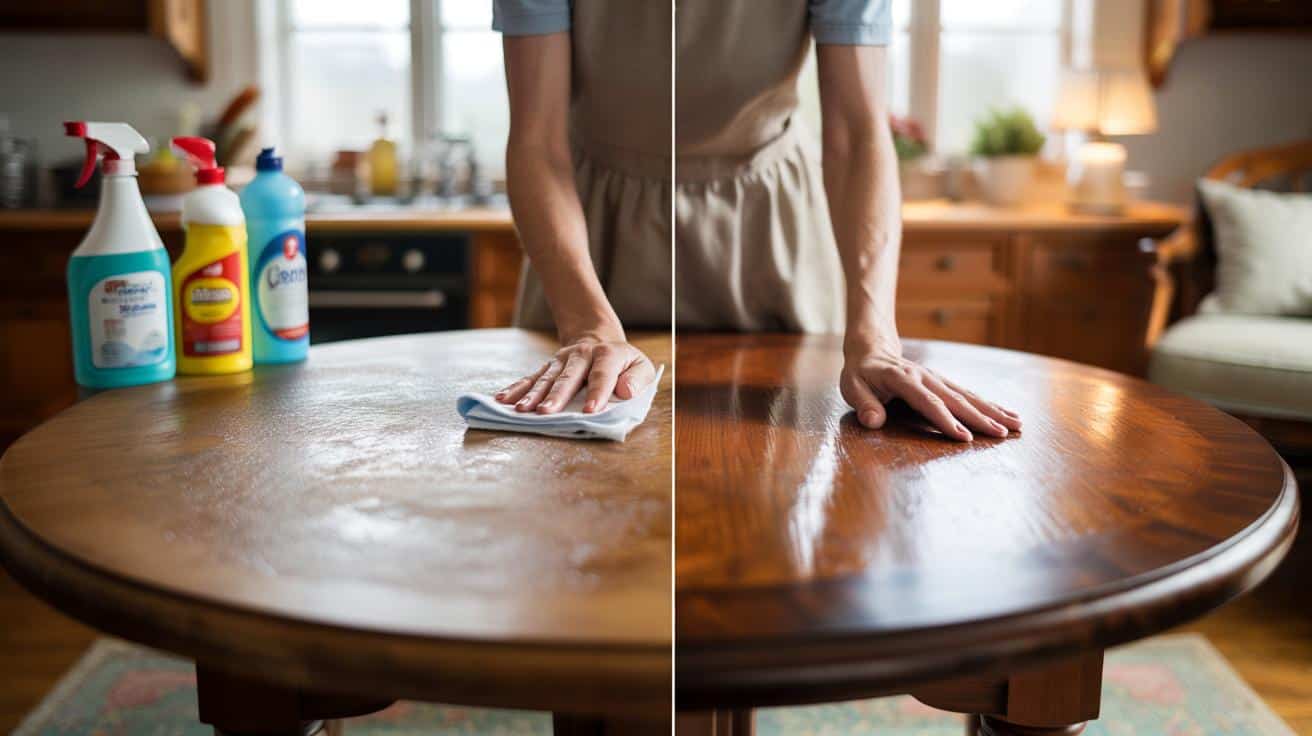
Most people blame age. They talk about “wear and tear”, as if time has quietly eaten away at the beauty. In reality, what you’re seeing is not always damage to the wood. It’s a clash of two eras living awkwardly on the same surface: old-school finishes and ultra-modern cleaning products that were designed for kitchen counters, not shellac or wax.
There’s a quiet statistic hiding in the trade: professional restorers will tell you that a huge share of “damaged” antique furniture they see hasn’t been scraped or gouged. It’s been slowly dulled by sprays that promise shine and hygiene. A 19th-century table ends up coated in a 21st-century cocktail of silicones, detergents and perfumes. Each vigorous wipe spreads another thin film over the original finish. Week after week, year after year, that film builds up into a greasy, matte haze that no one understands.
One restorer I met in Birmingham showed me a Victorian writing desk that a family thought they’d ruined with bleach-based wipes. The top looked patchy and flat, with ghostly rings where tea mugs had sat. They were convinced the veneer was “done for” and budgeted for a full strip and refinish.
Instead, he spent two careful sessions using a mild cleaner made specifically for waxed and shellac finishes. No sanding, no harsh solvents, just patient work. Under the gunk of supermarket sprays and polish silicone, the original warmth was still there. The rings were mostly in the grime, not the wood. The family had been mourning a surface that wasn’t actually dead – just smothered.
Stories like this repeat across the UK. Charity shop finds that look beyond saving. Dining tables that “aged badly” right around the time someone switched to antibacterial wipes. The timing is rarely a coincidence. Old finishes were made to handle soapy water and an occasional wax, not a flurry of lemon-scented detergents. When those modern products hit the surface, they don’t rinse off cleanly. They cling, react, and slowly alter the way the finish bends light.
From a technical point of view, most older furniture was finished with shellac, lacquer, varnish or traditional waxes. These are film-forming finishes. They sit on top of the wood like a protective skin. Many modern cleaners include alcohols, surfactants, ammonia, or solvents designed to cut through grease and fingerprints on plastic, metal, or laminate.
On a 1980s kitchen cabinet, that can work fine. On a 1920s French-polished table, the same ingredients can soften the finish, dull the sheen, or leave microscopic pitting. That’s when you get that odd “white bloom” or patchy dull areas. Every enthusiastic clean makes it worse, as if you’re massaging the problem further into the surface. The tragedy is that people often misread this reaction as proof the furniture is beyond hope, when it’s still mostly a chemistry problem.
➡️ Abdominal fat after 60 responds better to timing than intensity
➡️ Paid to live on a remote island: what these programs typically ask for beyond the headline perks
➡️ Cheap moisturizers rank high because skin doesn’t recognize branding
➡️ How emotional overload distorts perception of problems
➡️ Why some people greet dogs: psychologists connect it to social openness, not “quirkiness”
➡️ Injecting water into oil fields: why it can reduce sinking—until it doesn’t
➡️ How people naturally reset after social interactions without isolating
How to clean old finishes without killing their glow
The first practical step is almost painfully simple: stop throwing the entire cleaning cupboard at your old furniture. Pause the sprays, step away from multi-purpose wipes, and reach for something gentler. A soft, barely damp cloth with plain lukewarm water is often the safest starting point. Not soaked. Just lightly moistened, then well wrung out.
Work in small areas and wipe very lightly, then follow immediately with a dry, clean cloth. You’re not scrubbing a roasting tin; you’re lifting surface grime. If you’re dealing with built-up polish or years of sticky residue, a cleaner specifically designed for antique or waxed furniture can be worth its slightly higher price. Many restorers quietly swear by them.
After cleaning, a thin coat of good-quality paste wax can transform the way an old finish looks. Not a syrupy spray polish that smells like an air freshener, but a solid tin of beeswax or microcrystalline wax made for furniture. You apply a fingernail-thin layer with a soft cloth, leave it to haze, then buff gently. The change isn’t Hollywood dramatic, yet that gentle, low, human glow often creeps back.
This is where habits get in the way. A lot of people still use kitchen-style products on everything because they’re fast and familiar. Spray, wipe, walk away. Life is busy, kids smear fingerprints on every surface, pets jump onto tables. You just want things to look clean.
On a laminate sideboard from a flat-pack store, that routine is usually fine. On Grandma’s mahogany dining table, it slowly erodes what makes it special. And yes, the “right” method is less convenient. You might need a separate cloth and a separate product that lives away from the bleach and bathroom cleaners. Soyons honnêtes : personne ne fait vraiment ça tous les jours.
On a practical level, aim to *dust more, deep-clean less*. Regular dry dusting with a soft cloth or microfibre stops grit acting like sandpaper and keeps the finish from getting grimy enough to tempt aggressive cleaners. Then, maybe once or twice a year, do that careful clean-and-wax ritual. Think of it as a seasonal service, not a daily chore.
The emotional weight tied to old furniture makes people nervous. They worry about “doing the wrong thing” to Nana’s wardrobe or the table where every Christmas happened. It’s easy to panic and overreact as soon as the surface looks off. You’re not alone in that. On a bad day, one harsh product grabbed in a rush can undo years of gentle patina in fifteen brisk seconds.
Professionals often share the same simple principle: if you wouldn’t put it on your own skin without thinking twice, don’t put it on a 120-year-old finish. Strong oven cleaners, bleach sprays, abrasive creams – they don’t belong anywhere near shellac or traditional waxes. Even some “miracle” furniture polishes load the surface with silicone, which might look glossy at first but makes future restoration far more difficult.
One veteran restorer told me something that sticks:
“Ninety per cent of what people call damage is really just bad cleaning layered over good craftsmanship. The wood is more stubborn than we are.”
So what can you actually do, in real life, without turning into a museum conservator?
- Keep modern all-purpose sprays for the kitchen, not the antique dresser.
- Test any new product on a hidden spot first and wait a full day.
- Use a soft cloth, not rough sponges or scrub pads.
- Favour specialist furniture cleaners and real wax over silicone sprays.
- If in doubt, stop early and ask a local restorer before things escalate.
Rethinking “old and dull” in a modern home
Once you’ve seen how violently modern cleaners can clash with old finishes, you start looking at “tired” furniture differently. That chalky patch on the arm of a chair might not be a ruined finish. It might just be the ghost of years of antibacterial sprays. That cloudy ring on a coffee table might not be a death sentence. It could be a stain in the build-up, not the wood.
There’s a quiet satisfaction in rescuing a piece this way. You’re not sanding away its history or erasing the marks of use. You’re peeling back a layer of the past decade to let the past century breathe again. On a personal level, it changes how you see your home. Instead of classifying things as “old and tatty”, you start thinking: what if this is just reacting badly to the life I’m forcing on it?
On a larger scale, there’s a sustainability story here. Every sideboard wrongly pronounced “ruined” and chucked on the kerb is another piece of solid timber replaced by chipboard. Each time a finish is aggressively stripped and redone because it “looked old”, a little bit of character disappears. Restorers will quietly tell you that restraint is underrated. A gentle clean, a rethink of the products you use, and a bit of respect for the chemistry of old finishes can stretch a piece’s life for decades.
Next time you catch yourself eyeing that dull dresser or the table that no longer shines for Instagram, pause before you blame age or imagine catastrophic damage. Ask a different question: what has this surface actually been fed for the last ten years? The answer might feel uncomfortably like a shopping list from the cleaning aisle – and that’s where the story really starts to change.
| Point clé | Détail | Intérêt pour le lecteur |
|---|---|---|
| Les nettoyants modernes réagissent avec les finitions anciennes | Alcool, ammoniac, solvants et silicones peuvent ramollir, ternir ou encrasser le vernis, la cire ou la gomme-laque | Comprendre que le meuble n’est pas forcément “abîmé”, mais seulement masqué par de mauvais produits |
| Un nettoyage doux suffit souvent à réveiller l’éclat | Chiffon légèrement humide, nettoyant spécialisé, fine couche de vraie cire puis lustrage léger | Offrir une méthode concrète pour redonner vie à un meuble sans ponçage ni décapage lourd |
| Changer de routine prolonge la vie des meubles | Dépoussiérage régulier, abandon des sprays multi-usages, produits adaptés aux finitions anciennes | Éviter les erreurs coûteuses, préserver la valeur émotionnelle et financière des pièces |
FAQ :
- How can I tell if my furniture has an old-style finish?You’ll often see a warm, slightly uneven sheen rather than a hard plastic shine. Shellac and older varnishes can show fine crazing lines, and waxed pieces feel smooth but not slippery. If a tiny dab of methylated spirits on a cotton bud softens the surface on a hidden area, it’s likely shellac or a similar traditional finish.
- Are furniture polish sprays really that bad?Many contain silicones and strong solvents. They can create short-term shine but build up a cloudy film and complicate any future restoration. Used once in a blue moon, they’re not catastrophic, yet regular use on antique finishes is a common cause of dull, greasy-looking surfaces.
- Can I fix white rings and cloudy patches myself?If the mark is in the surface build-up, a gentle specialist cleaner and wax might reduce it dramatically. If the ring has penetrated into the finish or wood, you may need a professional. Always try the least aggressive approach first on a small, hidden test patch.
- Is it safe to use vinegar or homemade cleaners on old wood?Vinegar is acidic and can slowly attack finishes, especially shellac and some varnishes. Homemade mixes that circulate online often sound “natural” but aren’t designed for antique surfaces. Plain water, specialist cleaners and proper waxes are usually safer choices.
- When should I call a professional restorer?If the finish is flaking, deeply cracked, or sticky to the touch across large areas, a restorer can stop things getting worse. Also seek help before stripping, sanding, or using strong chemicals – a quick consultation can save both the piece and your wallet.