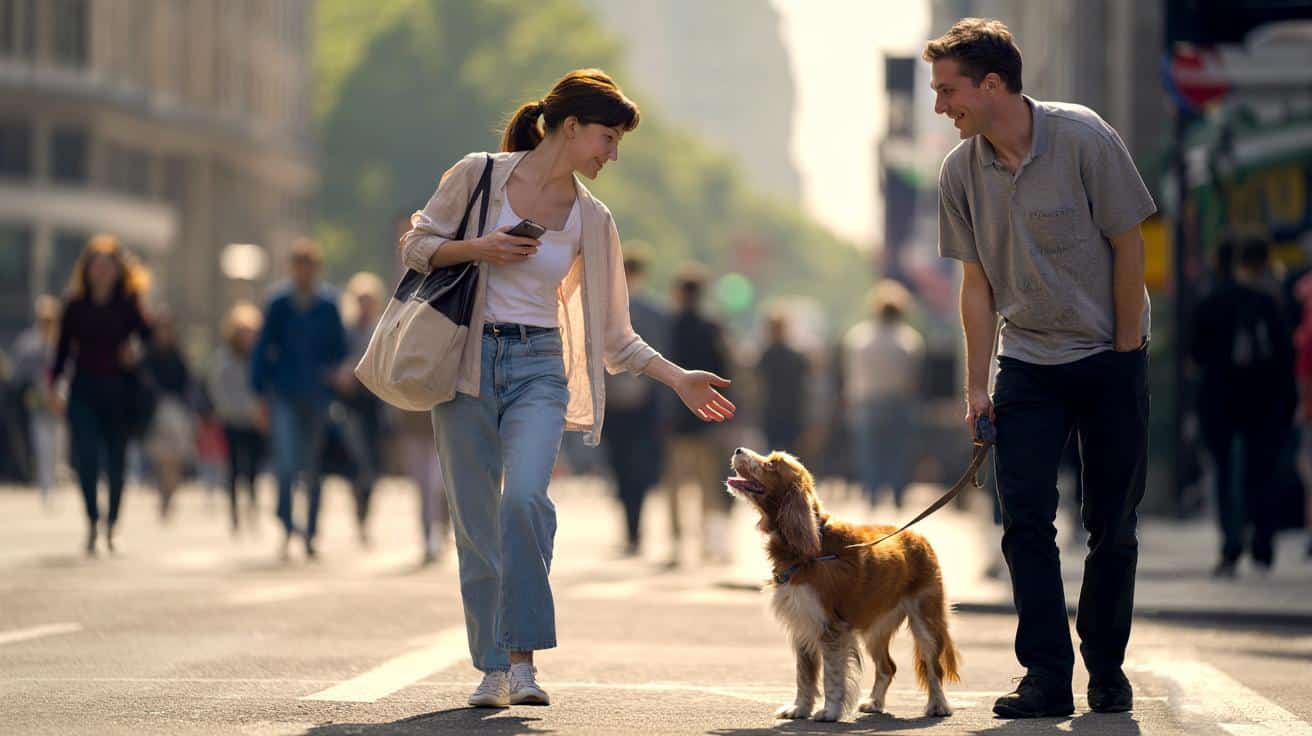
The woman doesn’t even slow down.
One hand on her phone, the other around a tote bag, she passes a stranger on the pavement and… smiles straight at his dog. “Hi gorgeous,” she murmurs to the spaniel, before barely nodding at the man on the lead end.
He laughs, half-flattered, half-invisible. The dog’s tail goes into helicopter mode. People weave around them, rush-hour in a London side street, but for a second the only thing that exists is this tiny, furry social bridge.
You’ve seen this scene a thousand times. Maybe you’re the one greeting dogs like old friends. Maybe you’re the one watching, thinking: “Why are we talking to animals like tiny, hairy people?”
Psychologists have been quietly studying that exact question. And what they’re starting to say about it might change how you see those “dog people” forever.
Why we talk to dogs like they’re people
On a busy city street, there’s a silent rule: avoid eye contact, keep your bubble intact, move on. Then someone spots a dog and the script shatters. Voices soften. Shoulders drop. Time slows down by half a beat.
Dog-greeters often look like they’re breaking social norms. They crouch on wet pavements. They squeak “hello!” in baby voices. They chat to a cockapoo as if it has a mortgage and weekend plans. From the outside, it can look slightly absurd. Inside, though, something very human is happening.
Psychologists link this behaviour to a trait called social openness. People who greet dogs are usually more willing to make micro-connections in public spaces. They’re less guarded, less frozen by the “don’t be weird” rule we carry into adulthood. What looks like quirkiness is, in many cases, just a low-stakes way of saying, “I’m open to you.”
In one 2023 online survey of pet owners and non-owners across the UK, researchers asked people how often they spoke directly to animals in public. The group who talked to dogs more frequently also scored higher on measures of extraversion and what psychologists call “agreeableness” – traits tied to warmth and trust.
That doesn’t mean all dog-greeters are loud or outgoing. One introverted respondent described dogs as “social shortcuts” that spared her from awkward small talk with humans. She found it easier to say “Hi, handsome boy!” to a Labrador than “Nice weather” to its owner.
On a park bench in Manchester, a 52-year-old nurse told me she’d started greeting dogs during the pandemic. She was exhausted, emotionally flat, walking home late from shifts. One evening she bent down to say hello to a shaggy terrier outside a corner shop. “He just looked at me like I existed,” she said. “I realised I hadn’t felt that in days.”
➡️ How people naturally reset after social interactions without isolating
➡️ Cheap moisturizers rank high because skin doesn’t recognize branding
➡️ How emotional overload distorts perception of problems
➡️ Injecting water into oil fields: why it can reduce sinking—until it doesn’t
➡️ Abdominal fat after 60 responds better to timing than intensity
➡️ Boiling rosemary: the simple habit that changes the vibe of a room (and the ventilation tip)
When psychologists dig into these stories, a pattern appears. Dog-greeting isn’t just a random habit; it’s a tiny social valve. It lets out pressure from lives that are busy, digital, and carefully curated. You can be awkward with people. Dogs don’t care.
Underneath the silliness, it’s a rational move. Human brains are wired to respond to eyes, faces, and signs of friendliness. Dogs evolved to hold our gaze and read our emotions. When someone locks eyes with a passing spaniel, their social circuits light up without the usual risks: there’s no fear of rejection, no performance, no need to be witty.
Psychologists describe this as “safe connection”. The dog is a soft gateway to the wider social world. Greet the dog, maybe share a smile with the owner, walk away with a faint sense that people might be less scary than your newsfeed suggests.
How to greet dogs in a way that feels good for everyone
If you’re a natural dog-greeter, you probably act on instinct. Still, there’s a simple method that turns those quick encounters into something more respectful and less awkward for everyone involved.
First, you greet the human. A brief “Is he friendly?” or “Can I say hello?” signals that you see the owner as more than a lead-holder. Many owners relax at that point; they’ve been taught to be wary of strangers rushing in hands-first.
Then you lower your body language. Knees slightly bent, hand relaxed by your side, eyes not boring straight into the dog’s face. You let the dog come to you, not the other way round. It’s slower, quieter, almost like knocking before entering a room.
When things go wrong, it’s rarely out of malice. Most people who get it slightly off are just enthusiastic. They rush in, squeal, pat the top of the head, maybe lean over the dog. Some dogs tolerate it. Anxious ones don’t.
Owners carry that tension. A woman with a rescue greyhound in Bristol told me it took months before she stopped dreading strangers’ hands. “They meant well,” she said, “but every time someone lunged in, he froze. Then I froze. It was exhausting.”
There’s also the quiet shame some people feel about talking to dogs at all. They worry they look childish, or lonely, or odd. So they swallow the urge, stare straight ahead, and miss the micro-moment of connection they were reaching for. *We’re experts at pretending we don’t need tiny things that actually keep us going.*
One London psychologist I spoke to put it bluntly:
“Greeting a dog isn’t weird. It’s one of the last socially acceptable ways to say, ‘I want to connect’ without sounding needy. The people who do it most are often the ones most comfortable with being seen.”
That doesn’t mean turning every walk into a petting zoo. Social openness has boundaries. Reading the room – and the lead – is part of the art. Some owners are in a rush. Some dogs are working. Some people are dealing with grief, anxiety, or just a terrible day. A nod from a distance can be enough.
- Watch the dog’s body language before you move in.
- Ask the owner in a calm, normal voice, not a squeal from ten feet away.
- Keep it brief; you’re offering connection, not demanding a full conversation.
- Accept “no” with a smile. It’s about safety, not a judgement on you.
- Notice how you feel afterwards. That tiny lift is your social brain saying “thanks”.
What greeting dogs reveals about who we are
On paper, it’s such a small act. A two-second “hello, mate” to an elderly collie outside a shop. But when psychologists map behaviour across thousands of people, patterns start to glow.
People who greet dogs often score higher on measures of curiosity and emotional responsiveness. They report feeling less awkward making eye contact with strangers. Many describe dogs as “social icebreakers” or “permission to be soft in public”. The dog becomes a tiny loophole in the unwritten rule that adults must be self-contained, brisk, and mildly bored-looking on the street.
On a deeper level, those moments tell a quiet story about how we see other beings. To greet a dog is to act as if its inner life matters. You’re projecting personality, imagining feelings, allowing yourself to care about a creature you’ll never see again. Some call that childish. Psychologists tend to call it empathy.
That doesn’t mean people who ignore dogs are cold or broken. Personal history plays a role. If you grew up in a culture where dogs were kept outside or seen as dirty, that shapes your instinctive reactions. If you were bitten as a child, your nervous system might simply not let you bend down and coo at a stranger’s spaniel. Soyons honnêtes : personne ne fait vraiment ça tous les jours.
There’s also the quiet group who love dogs but feel socially clumsy. They worry their voice will sound weird, that the owner will think they’re strange, that they’re “too old” to talk to animals in baby voices. So they look, smile internally, and walk on, carrying a tiny, private ache for contact they never quite claim.
When psychologists say greeting dogs is linked to social openness, they’re not handing out medals. They’re noticing that people who feel safe enough to show warmth in public tend to channel it somewhere. For many, dogs are that safe outlet.
In cities where loneliness numbers rise every year, that little outlet matters. A glance, a tail wag, a shared laugh with a stranger about who is really walking whom. These things don’t fix broken systems or cure deep isolation. They just make the next ten minutes feel slightly more livable. And sometimes that’s enough to get through the day.
| Point clé | Détail | Intérêt pour le lecteur |
|---|---|---|
| Dog-greeting reflects social openness | Studies link talking to dogs with traits like warmth and curiosity | Helps you understand your own and others’ behaviour |
| There’s a respectful way to do it | Ask the owner, read the dog’s body language, keep it brief | Lets you enjoy contact without stressing dogs or humans |
| Small moments, real impact | Micro-interactions with dogs can ease tension and spark human connection | Shows how tiny habits can soften everyday loneliness |
FAQ :
- Is greeting dogs really linked to personality traits?Several studies suggest people who often talk to or greet animals tend to score higher on social openness, agreeableness and emotional responsiveness, though it’s not a strict rule.
- Does ignoring dogs mean I’m less empathetic?No. Cultural background, past experiences, allergies or fear can all shape how comfortable you feel around dogs, without saying much about your overall empathy.
- What’s the safest way to greet a dog I don’t know?Start by speaking to the owner, stand side-on, let the dog approach you, and offer a relaxed hand rather than reaching over its head.
- Why do I feel happier after saying hello to a dog?Physical contact and friendly interaction with animals can trigger feel-good hormones like oxytocin, and the brief social connection can ease stress.
- Is it odd to talk to my own dog like a person?Psychologists generally see it as a sign of strong bonding and social imagination, not a problem, unless it replaces meaningful human relationships entirely.