The engineer’s hard hat lamp cut a narrow circle of light in the dark control room.
On one side, a wall of screens showed pressure curves and water volumes; on the other, an old, faded map of the oil field, yellowed at the edges, still pinned with red flags from the eighties. Outside, in the desert heat, pumps hummed and the ground looked perfectly calm. Inside, people were quietly talking about subsidence, fault lines, and a village a few kilometres away that had started to crack.
They were injecting water into the reservoir to keep the pressure up. To stop the land from sinking. To squeeze more oil out before the field died.
On the map, a thin blue pen line showed where water had moved underground over the last decade. It stopped abruptly at a fault, like a river against a cliff. Someone tapped it and said, almost in a whisper: “If it crosses that line, everything changes.”
What happens when you “re-fill” an oil field with water
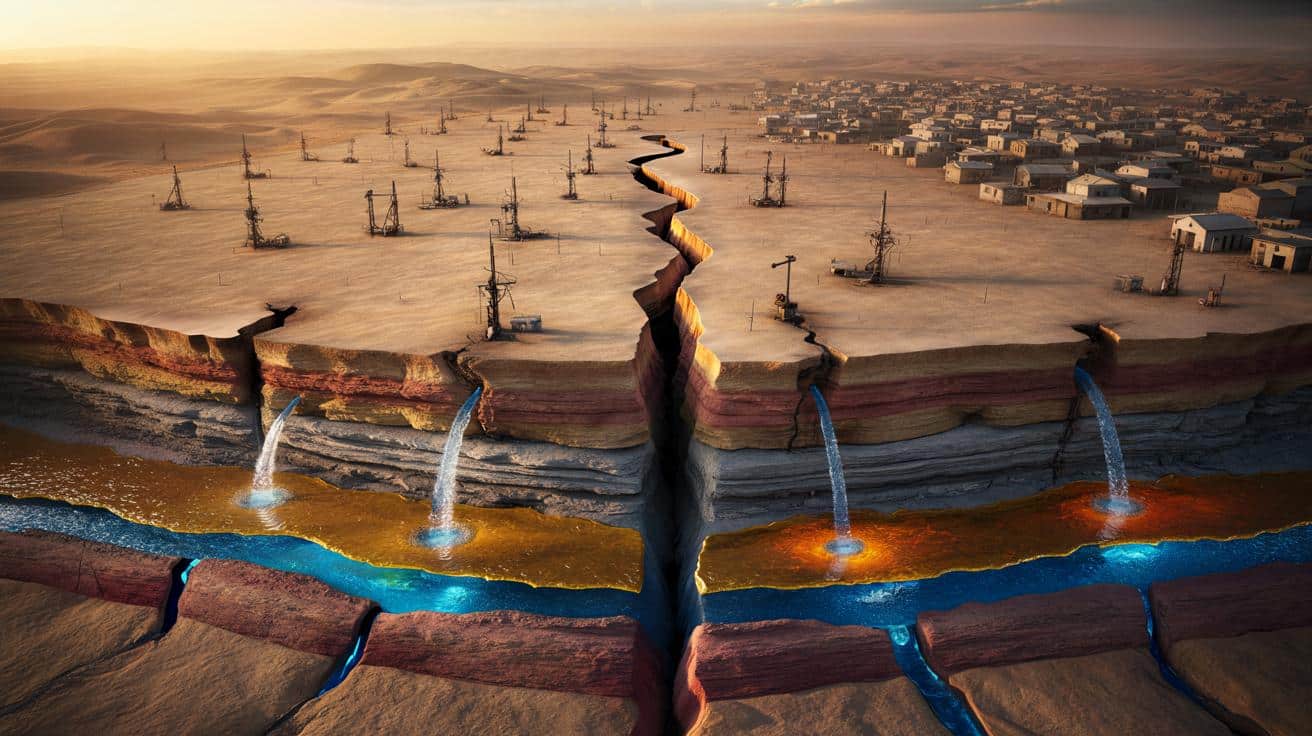
Water injection sounds calm and almost domestic. In reality, it’s more like forcing a huge underground sponge to reshape itself. Oil and gas were taken out, pressure dropped, and the rock compacted a little. Inject water back in, and for a while the system looks stable again. The ground above stops sagging quite so fast.
You can feel the optimism in old field reports: subsidence curves flattening, production recovering, risk assessments quietly downgraded. People like the idea that you can fix what you’ve disturbed with a controlled, technical gesture. It feels tidy. It feels adult.
But underground, the rock has a memory. Layers that squeezed once don’t always bounce back. Some pores collapse and stay collapsed. Water follows the easiest paths, not the ones drawn on the engineer’s model. The field looks steady from the surface, until one day it isn’t.
Look at the classic cases: the Ekofisk field in the North Sea, or Wilmington in California. At Ekofisk, the seabed sank by several metres after decades of production. Platforms had to be raised. Water injection was part of the response, an effort to stabilise pressure and slow the sinking. It worked for a while, but the story there is a long, tense balancing act between extraction and subsidence.
In Wilmington, near Long Beach, the ground had dropped by roughly nine metres in some places by the mid‑20th century. Streets cracked, pipes twisted. When operators began injecting water systematically, the subsidence slowed dramatically. The city almost breathed out in relief. The lesson seemed straightforward: take out fluids, the land sinks; push fluids in, the land calms down.
Years later, geologists reading the data saw something subtler. Different zones in the reservoir moved differently. Some layers stabilised; others started to deform in new ways. Faults that had been quiet woke up just a little. The picture wasn’t a simple before-and-after fix. It was a shifting chessboard, with each pawn pushed by pressure from below.
From a physics point of view, water injection is pressure management with a moral hangover. Extracting oil and gas lowers the pressure holding up the rock skeleton. The grains compact, the overlying layers sink, and at the surface, buildings and roads feel that as subsidence. When you inject water, you’re trying to carry some of that load again, to “reinflate” the system enough to slow the sinking.
➡️ How emotional overload distorts perception of problems
➡️ Old furniture looks dull not because it’s damaged, but because the finish reacts to modern cleaners
➡️ Cheap moisturizers rank high because skin doesn’t recognize branding
➡️ Abdominal fat after 60 responds better to timing than intensity
➡️ “Poor people’s fish” returns when supply chains favor local catch again
➡️ Boiling rosemary: the simple habit that changes the vibe of a room (and the ventilation tip)
➡️ How people naturally reset after social interactions without isolating
The catch is that reservoirs are rarely tidy boxes. They’re broken by faults, they have hard layers and soft layers, and their permeability can change as they deform. Water doesn’t politely fill every corner; it rushes through the easiest highways, sometimes bypassing entire regions. So you can have pockets still collapsing while others are pushed, even over‑pressured.
That’s where the “until it doesn’t” comes in. Raise pressure too far near a fault, and the rock may slip a few millimetres. Those millimetres can trigger micro‑earthquakes, shift stress into neighbouring layers, and slightly re‑route the whole pressure field. A method sold as stabilising can, in certain settings, start to redistribute the risk instead of removing it.
The delicate art of injecting just enough water
Inside modern control centres, teams now treat water injection almost like flying a plane through turbulence. They nudge injection rates up or down, watching pressure sensors deep in the wells. If the curve rises too sharply, they back off. If it flattens too much, they increase the volume. The goal is a narrow “Goldilocks zone” where the rock is supported, but not overstressed.
On a practical level, this means segmenting the injection: different wells, different layers, different targets. Some operators use alternating injection and production cycles, pulsing the reservoir rather than pushing it steadily. Others introduce tracers into the water to map where it actually goes, not just where the model says it should. The method looks dry in a PowerPoint slide, yet on site it feels more like steering through fog with only partial instruments.
On a human level, there’s also the politics of “enough”. Local communities want zero subsidence. Investors want maximum recovery. Regulators want to avoid headlines about collapsing ground or triggered tremors. So engineers end up as mediators between pressure curves and people’s expectations. *They know that the wrong number on one dashboard can mean cracks in someone’s kitchen a few years later.*
The most common mistake is to treat water injection as a magic undo button. It isn’t. When companies rush to maximise recovery, they can be tempted to use water like a hydraulic battering ram: more volume, higher pressure, faster results. Subtle warning signs — small induced quakes, uneven ground motion measured by satellites, strange pressure responses in remote wells — get waved away as “noise”.
We all know how that story often ends. A fault slips, a cluster of tremors hits the news, or a town reports sudden cracks after years of quiet. The narrative switches overnight from “stabilising the field” to “triggering earthquakes”. On a technical level, the cause is complex and incremental. On a human level, it feels like a broken promise.
Soyons honnêtes : personne ne lit vraiment les long technical annexes where those risks are spelled out in cautious language. So when something goes wrong, people feel blindsided. Operators then swing to the other extreme, cutting injection sharply, sometimes creating fresh instability. The pendulum keeps moving between overconfidence and overreaction.
“Water injection doesn’t stop subsidence; it negotiates with it,” a reservoir engineer in the Gulf once told me over lukewarm coffee. “You’re always bargaining with the rock, and the rock doesn’t always bargain in good faith.”
On the best‑run fields, teams build in small rituals of doubt. They schedule regular “red team” reviews, where independent geoscientists challenge the reigning model. They invite local authorities to see live data, not just polished annual reports. They accept that some parts of the reservoir may never be safely supported and leave that oil in the ground.
- Use diverse data: combine satellite InSAR, microseismic monitoring, well logs, and surface surveys to catch early shifts.
- Respect faults: treat mapped and suspected faults as moving boundaries, not fixed lines.
- Plan exit ramps: design injection strategies with clear thresholds for slowing or stopping operations.
- Talk like humans: explain uncertainty and risk in plain language to nearby communities.
Living with the “until it doesn’t” moment
There’s a quiet moment that operators don’t like to talk about. It’s when the data starts to hint that the ground is changing in a way the model didn’t predict. Not a disaster, not yet. Just a cluster of micro‑quakes in a zone that was supposed to be calm, or a satellite map with a faint new stain of uplift where there should be nothing at all.
On paper, this is when protocols kick in: risk assessments, scenario trees, revised injection plans. In real life, it’s also when careers, budgets, and public promises hang in the balance. Do you admit you may have mis‑read the rock, slow injection, and leave some barrels in the ground? Or do you convince yourself it’s “temporary noise” and wait for the next monthly report?
We’ve all lived that moment where a small warning sign in our own lives was easier to ignore than to face. In the subsoil of mature oil fields, the same psychology applies, only with more zeroes and more people on the line.
The future of water injection will probably look less heroic and more modest. More fields will use smart completions, fine‑tuned to individual layers rather than whole reservoirs. Artificial intelligence will sift through masses of subsidence and seismic data, flagging patterns that a human eye would miss. Some regions will ban injection near critical infrastructure or known sensitive faults, turning whole zones into “no‑pressure” corridors.
There’s also a cultural shift, slow but real. Younger engineers talk more openly about uncertainty. They share near‑miss stories at conferences, not just success cases. They are, in a sense, trying to rebuild trust in an industry where the ground has literally moved under people’s feet. *Not as heroes who fix everything, but as technicians who admit that some systems remain stubbornly wild.*
The unresolved question lingers: how much intervention is too much for a landscape already altered by decades of drilling? Injecting water into oil fields can, and often does, reduce sinking. It buys time for cities, pipelines, and coastlines. It gives operators a bridge between past extraction and a lower‑carbon future.
Yet each cubic metre of water pushed underground is also a new nudge to a very old structure. The rock listens. It reacts on its own timeline, not ours. Sometimes, it cooperates. Sometimes, it waits years before revealing where the real stresses have gone.
That’s why stories of subsidence and injection keep surfacing in the news, catching people off guard. They expose a basic unease about how far we can go in rearranging invisible systems without fully grasping the delayed consequences. They invite awkward questions: not only “Is this safe?” but also “Safe for whom, and for how long?”
In the end, water injection is less about engineering perfection and more about collective appetite for risk. How many centimetres of sinking are we willing to trade for another decade of oil production? How much invisible movement beneath our houses feels acceptable if the lights stay on and the fuel keeps flowing?
Those are not questions that geophysics alone can answer. They belong at kitchen tables, in town halls, and in the quiet spaces where people weigh today’s comfort against tomorrow’s uncertainty. The ground may look solid as we walk across it. Somewhere deep below, that bargain is still being renegotiated.
| Point clé | Détail | Intérêt pour le lecteur |
|---|---|---|
| Water can slow sinking | Injecting water restores some lost pressure and can significantly reduce subsidence in many oil fields. | Helps understand why operators claim injection “protects” cities and infrastructure. |
| But it reshapes underground stress | Uneven pressure changes can activate faults and trigger micro‑seismicity or new deformation. | Explains why stabilisation efforts sometimes lead to fresh risks or headlines. |
| Monitoring and honesty are crucial | Multi‑layer data, transparent communication, and clear stop‑rules reduce long‑term surprises. | Gives readers concrete signs to watch for in local debates about oil fields and subsidence. |
FAQ :
- Does water injection always reduce land subsidence?Often it does, especially where subsidence is mainly driven by pressure loss in a well‑understood reservoir. Yet results vary by geology, injection design, and field history, and some zones may keep moving even as others stabilise.
- Can water injection cause earthquakes?It can trigger small quakes if pressure builds near faults that are already close to slipping. These are usually low magnitude, but in rare cases they can be felt at the surface or interact with larger fault systems.
- Is water injection the same as fracking?No. Fracking uses short, high‑pressure bursts to crack rock and create new pathways, while water injection is typically a long‑term, lower‑pressure process meant to support pressure and sweep oil towards production wells.
- How do scientists track ground sinking or uplift?They combine satellite radar (InSAR), GPS stations, levelling surveys, and sometimes even laser scans of buildings and roads to detect movements of just a few millimetres over large areas.
- What can local communities ask for near an oil field?They can push for transparent monitoring data, independent reviews of injection plans, clear thresholds for slowing or halting operations, and public reporting on both subsidence and induced seismicity.